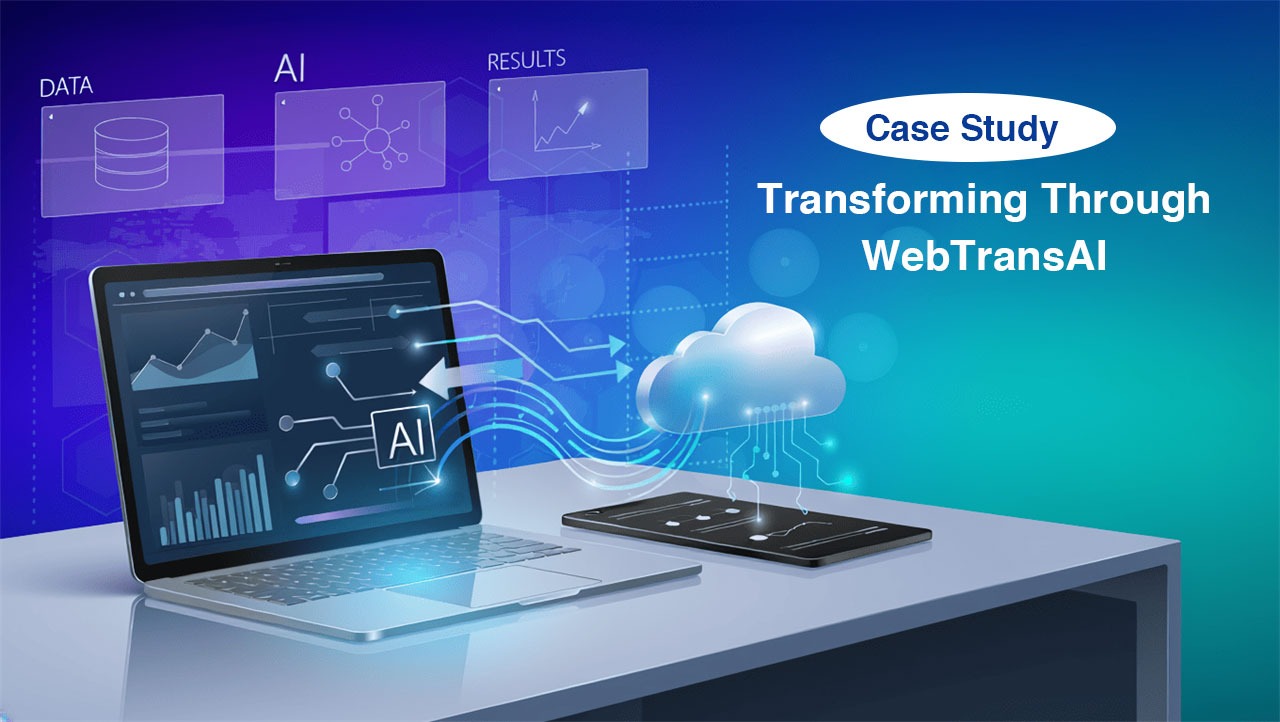
Website translation has democratized access to global markets, and the rapid advancement of AI has accelerated that shift faster than anyone anticipated. For businesses pursuing international growth through digital-first channels, the priorities are speed, features, and cost efficiency. But the markets that matter most consistently reward something harder to automate credibility and trust.
Keeping those values intact, WebTrans AI was not tested on a controlled demo environment or a set of handpicked pilot clients. It was deployed on live websites first — two organizations operating across the UAE and India, ran WebTrans AI on their active digital presences before it was offered externally. Every gap in the platform would have shown up on websites we were directly accountable for.
The deployments in this case study reflect that standard. ICS Dubai is a translation services company in the UAE. India Is Us is a national NGO and social impact platform. These are live, business-critical websites where translation quality, speed, and reliability directly affect real outcomes.
What follows is an account of those two deployments — the challenges both organization faced, how the platform addressed them, and what changed as a result.
ICS Dubai
The Problem
ICS Dubai is a firm operating in the UAE — a market where Arabic is not just a language preference but a cultural expectation. Every Arabic-speaking visitor arriving to explore their services was met with content in English only.
The team had identified the gap. The challenge was finding a practical path to close it. A traditional agency build would have taken weeks and created ongoing overhead for every content update. A machine translation plugin would have deployed quickly — but without a quality review layer, which was a particular concern for an organization whose work is centered on translation accuracy.
The Solution
WebTrans AI crawled the ICS Dubai website and extracted every visible content segment — service descriptions, navigation labels, trust content, and calls to action. Content was pre-translated using DeepL, routed for Arabic professional content. Every segment moved through the reviewer console, where a certified Arabic linguist reviewed and approved each one before anything went live. The JavaScript snippet was added to the site head in under an hour. No pages were rebuilt. No URLs changed. The Arabic version went live as a language-switched overlay on the existing site, served from CDN cache with no performance impact.
The implementation took less than two days from first crawl to Arabic going live — including full professional human review of every segment. Because the translation pipeline is continuous, every English content update automatically surfaces in the reviewer console for Arabic review.
India Is Us
The Problem
India Is Us is a fundraising and social impact platform that connects corporates, NGOs, and volunteers across India. Its mission: to make giving and volunteering genuinely accessible to every Indian, regardless of geography, background, or digital literacy. The platform was running entirely in English.
For India Is Us, the language gap was a mission-alignment issue. The communities the platform was designed to serve — grassroots NGOs, regional donors, and volunteers outside urban centres — were underserved by an English-only interface. Expanding reach to those audiences required the platform to operate in the languages they use.
The Solution
WebTrans AI deployed Hindi as the first target language, with the architecture designed for expansion to additional regional languages. The crawler extracted all platform content — cause listings, NGO registration pages, donation flows, volunteer onboarding content, and campaign descriptions. Google NMT was used for Hindi, which performs strongly on Indic language pairs.
The review model was primarily in-house. The platform's bilingual team used the reviewer console to approve translations directly. Donation flow and registration pages received segment-by-segment review. Navigation and standard platform text were bulk approved after the first review cycle. The entire Hindi deployment went live without any developer involvement after the initial snippet setup.
Key Features That Made the Difference
Two organizations. Two industries. Two language pairs. Two different review models. What made WebTrans AI the right infrastructure across both of them was not a single feature — it was how every layer of the platform works together as a continuous system.
Why WebTrans AI Stands Out
The website localisation market has established options. Traditional agencies deliver high quality for defined-scope projects and are less suited to continuous operation — each content update initiates a new project cycle, which creates cumulative lag for organisations that publish regularly.
MT plugins offer speed but no structural review layer. Raw machine translation output is not production-ready for brand-critical pages without a quality gate. WebTrans AI operates differently: content is translated and then held at a review stage — nothing reaches a visitor without passing through the approval lifecycle.
WebTrans AI occupies the space between those two approaches: AI speed at the draft stage, human quality at the gate, Translation Memory that compounds in value over time, and deployment that requires one script tag from your engineering team.
In a Nutshell
The platforms that will define the next decade of website translation are those built for continuous operation — not just in the features they offer, but in the infrastructure they run on and the workflows they enable.
WebTrans AI is built to be dependable: for accuracy, for consistency, and for the kind of quality that holds up when a prospect in a new market is deciding whether to trust you. Not the most feature-rich platform in the market — the most reliable one. The one your team can run continuously, your reviewers can trust structurally, and your international audience can feel on every page they read.
Translation infrastructure that earns trust is a business decision. The organizations that make it now will be well-positioned when the next wave of global markets opens.
We are here to assist with your questions. Write us a message, and we will get back to you shortly.

.png)