Most businesses discover they need a multilingual website long after the cost of not having one has already been paid in missed traffic, abandoned sessions and customers who quietly chose a competitor whose website spoke their language. The internet is inherently global, but most business websites are built as if their audience is not.
According to CSA Research, 76% of online consumers prefer to buy products in their native language, and 40% will never purchase from websites available only in English. These are not marginal preferences — they are purchasing decisions being made every day by visitors landing on websites that were never designed to receive them.
The question for most businesses is not whether multilingual support matters. It is whether they are already paying the price of not having it.
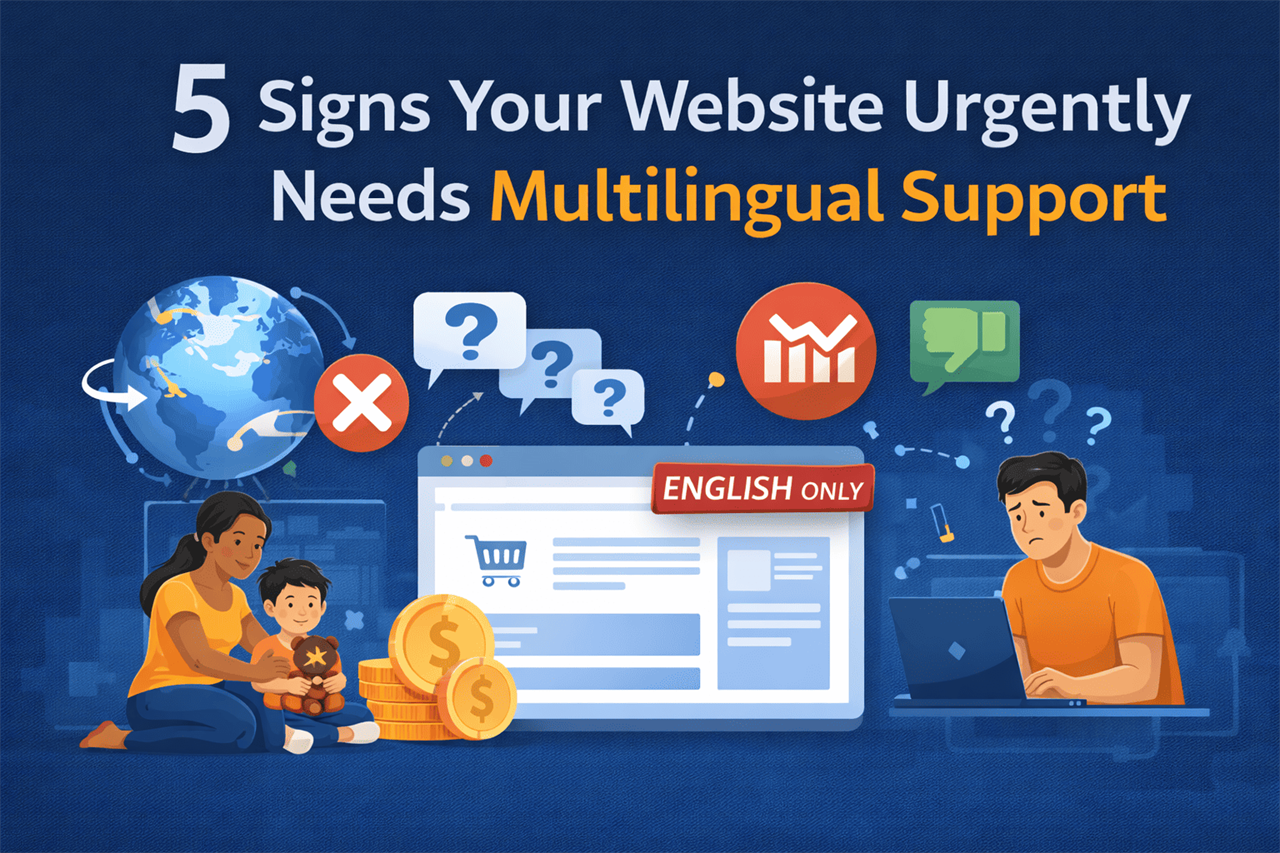
Here are five signs that your website has crossed from consideration to urgency.
This is the most revealing signal in your analytics, and the one most businesses misread.
When Google Analytics or any comparable platform shows you consistent organic or direct traffic from markets like the Middle East, Southeast Asia, Germany, France, Japan, or Latin America — but your conversion rate from those markets sits significantly below your domestic baseline — the most likely explanation is not the quality of your product or pricing. It is a comprehension failure.
A visitor who cannot fully understand your value proposition, your product descriptions, your calls to action, or your trust signals will not convert. They will leave. And they will leave without telling you why, which is what makes this pattern so easy to misattribute to campaign performance or audience mismatch when the real problem is entirely linguistic.
If your international traffic-to-conversion gap is widening, your website's monolingual architecture is almost certainly the reason.
High bounce rates are typically treated as a UX or content quality problem. In many cases, they are neither — they are a language problem wearing a UX disguise.
When a user arrives on your website from a non-English speaking country, reads the first paragraph of your homepage, and leaves within thirty seconds, that is not a sign of disinterest in your business. That is a failure of communication at the most basic level. The visitor arrived with intent — search engines do not send uninterested people to your website — but found a digital environment that could not serve them in any meaningful way.
The critical analytical exercise here is to segment your bounce rate by geography. If you find that your overall bounce rate looks acceptable but certain country-level bounce rates are dramatically elevated, particularly in markets where your language is not the dominant one, you are looking at a multilingual support problem, not a content quality problem. These are solvable with very different tools.
Search engine optimisation is inherently local. The crawlers do not deliver the same content to users residing in different geographies. If the dominant search language is Arabic, Hindi or Mandarin, Google does not rank English-only content well enough in those markets.
If your competitors, particularly regional players or international businesses with localised web presence, are consistently outranking you in markets where you have a legitimate commercial interest, language is certainly a contributing factor. Multilingual websites with properly implemented hreflang tags, localised metadata, language-specific keyword strategies, and culturally adapted content rank significantly better in non-English language searches than their English-only equivalents.
Multilingual SEO is not a premium feature for global enterprises; it is table stakes for any business that takes international organic search performance seriously. Every month your website remains English-only in a target market where the dominant language is not English is a month of organic ranking advantage you are ceding to competitors who made this investment earlier.
This is one of the most underrated indicators of a multilingual website and one of the most expensive to ignore.
When users from non-English speaking markets cannot find the answers they need on your website because the content is inaccessible to them, they do not give up. The ones with genuine purchase intent pick up the phone, send an email, or open a support ticket. Your customer support team then spends time answering questions that a well-localised FAQ page, product description, or help section would have resolved without human intervention.
The hidden cost of this pattern is significant. Multilingual customer support queries take longer to resolve, often require specialist handling, and represent demand that your website should be capturing and converting autonomously — not escalating to a human team. If your support volume from international markets is growing faster than your international revenue, your website is creating friction that localisation is designed to remove.
This sign is less about what your data is already telling you and more about what the absence of preparation will cost you.
Entering a new market with an English-only website is not a neutral decision; it is an active handicap. The digital first impression your business makes in a new market is formed the moment a potential customer lands on your website. If that website fails to communicate in their language, reflect their cultural context and cannot address their market-specific concerns, you have already lost a large chunk of the audience you invested in reaching.
The businesses that capture market share fastest when entering new geographies are those that localise their digital presence before or simultaneously with market entry — not as an afterthought once early results disappoint. Multilingual website support is not a post-launch optimisation in a new market. It is a launch prerequisite.
If you recognise your website in any of the signs above, the practical question becomes not whether to act but how to act without rebuilding your entire digital infrastructure.
This is where WebTrans AI — Softech's AI-powered website translation platform offers a genuinely different approach. WebTrans AI automatically crawls your website page by page, translates every segment using advanced AI engines and routes content through professional human linguist review before anything goes live. Critically, it deploys via a single JavaScript snippet — no CMS migration, no code overhaul, no redesign. Your existing site stays completely untouched, and your multilingual presence goes live in weeks rather than months. For businesses that need to move fast without breaking what is already working, WebTrans AI closes the gap between recognising the problem and solving it.
There is a common assumption embedded in the way businesses approach multilingual support that it is an expansion investment to be considered when international revenue justifies it. This assumption inverts the causality. International revenue rarely grows to the level that justifies multilingual investment if the multilingual investment is never made.
The visitors are already arriving. The traffic is already there. The international intent exists. The only missing part is a website capable of converting it.
If your analytics show the signs outlined in this article, the case for multilingual support is not future-facing, but a present concern that reflects in your data, support queue, search rankings, and the customers who visited your website found it inaccessible and went elsewhere.
Going multilingual opens access to new markets by leveraging the digital-first audiences that value cultural coherence in an ever-growing globalised world.
We are here to assist with your questions. Write us a message, and we will get back to you shortly.


.png)