Your website may already be doing everything right in English. It loads fast, looks polished, and converts well for the audience it was originally built for.
But that is only one version of your digital presence.
For a large share of your global audience, the experience is very different. They land on a page they partly understand, hesitate for a few seconds, and leave.
That gap is not a design issue. It is a language issue. And in 2026, it has quietly become one of the most avoidable growth leaks for businesses trying to scale across markets.
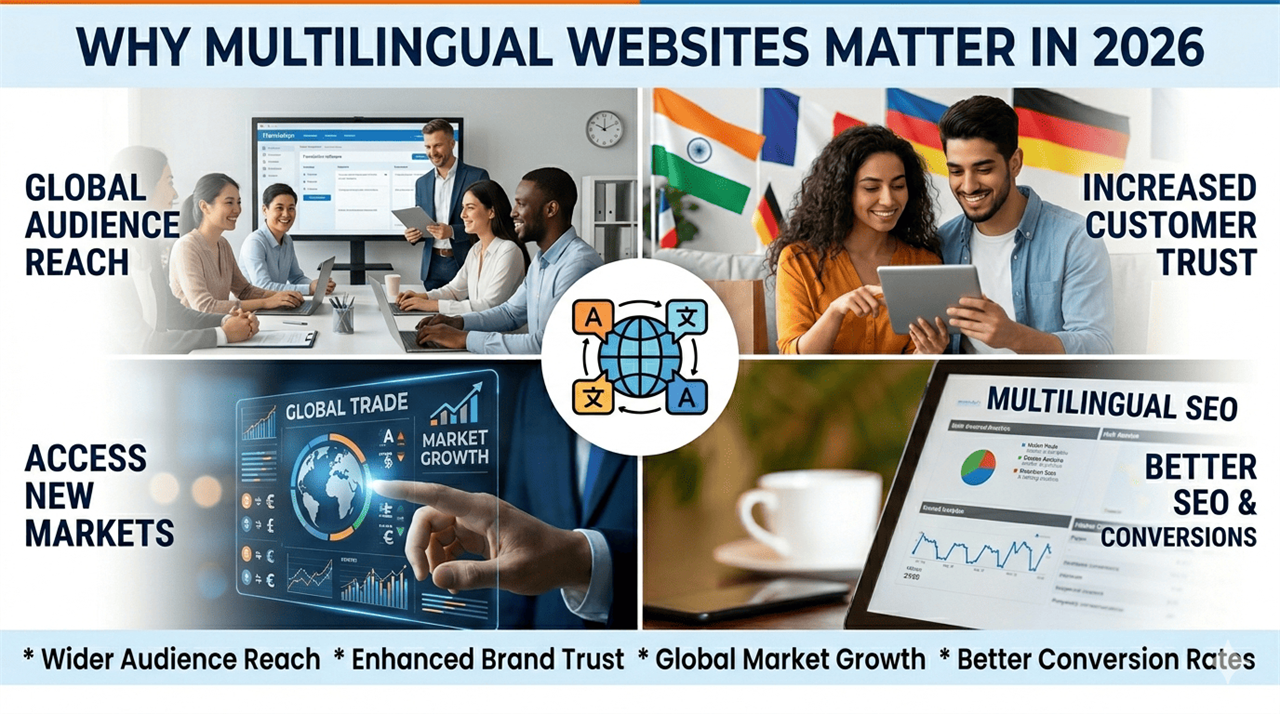
Research from CSA shows that 76% of online shoppers prefer to buy in their own language, while 40% will not buy from a website that is not available in their native language at all.
If your business is still relying on an English-only site, the question is no longer whether a multilingual website matters.
The real question is: how much demand are you already attracting, but failing to convert, because your website stops speaking the moment your audience changes?
The Internet Is Local Now
For years, English was treated as “good enough” for global reach.
That assumption does not hold anymore.
The internet has expanded through:
Today, 72.4% of consumers spend most or all of their time on websites in their own language.
This is not just about understanding content. It is about confidence.
People trust:
more when they are presented in the language they naturally think in.
That is why multilingual websites are no longer a feature. They are infrastructure.
The 5 Languages Driving Digital Commerce in 2026
If you are building a multilingual website, prioritisation should follow economic reality, not guesswork.
Here are five languages that define market access in 2026:
1. English
English still dominates global business and accounts for a large share of web content.
But English is not global coverage. It only serves the segment already comfortable with it.
An English-only website is not multilingual. It is limited reach.
2. Mandarin Chinese
China remains one of the largest economies globally, with IMF projections placing growth at 4.5% in 2026.
With over 1.1 billion internet users, Mandarin is not just a language option. It is a gateway to one of the largest digital economies in the world.
If your website does not support Mandarin, it is effectively invisible to that audience.
3. Spanish
Spanish connects over 20 countries and a rapidly expanding digital consumer base.
It is one of the most efficient languages for multilingual expansion because:
For many businesses, Spanish is the first real step into becoming a multilingual website.
4. German
Germany anchors Europe’s economy, with strong purchasing power and high buyer intent.
German users expect clarity and precision. If the experience feels translated instead of native, trust drops quickly.
This is where localisation, not just translation, becomes critical for conversion.
5. Arabic
Arabic spans 22 countries and over 400 million people, with strong economic clusters in the Gulf.
It also introduces a structural requirement: right-to-left user experience.
If layout and navigation are not properly adapted, it signals lack of seriousness immediately.
In Arabic markets, localization is not optional. It is a credibility filter.
Each of these languages represents more than words. They represent expectations.
A multilingual website that only translates text but ignores experience will not convert.
Why Most Multilingual Websites Fail
Most businesses understand the importance of multilingual websites.
Execution is where things break.
Translation without localisation
The words are correct, but the tone feels off. Cultural context is missing. The content reads flat.
No multilingual SEO
Translated pages go live without:
The result? Search engines cannot surface them effectively.
A page that cannot be found is not a multilingual asset. It is invisible content.
Over-reliance on raw machine translation
AI translation is powerful, but unsupervised output still fails where it matters most.
One mistranslated CTA or pricing line is enough to break trust.
These are not exceptions. This is how most multilingual websites operate today.
Where AI Website Translation Changes the Equation
Traditional localisation was built for static websites.
The process looked like:
That model does not work anymore.
Websites today:
Every update creates a gap between your main site and translated versions.
AI Website Translation introduces a system, not a project
Instead of one-time translation cycles, it creates a continuous workflow:
This changes multilingual websites from a maintenance burden into a scalable system.
AI + Human Review Is the Real Advantage
The strongest multilingual setups today are not AI-only or human-only.
They combine both.
AI handles:
Humans handle:
This balance is critical.
It allows businesses to move fast without sacrificing trust.
Why AI Website Translation Is Becoming the Default
At scale, traditional translation models start to break down.
AI website translation changes three core dynamics:
Speed
What used to take weeks now happens in hours or days.
Cost structure
Moves away from per-word pricing toward scalable systems.
Continuity
Your multilingual website becomes a live, evolving layer, not a static snapshot.
This is why businesses are shifting toward AI website translation as infrastructure, not just a service.
Multilingual SEO: The Compounding Growth Layer
One of the biggest advantages of multilingual websites is search visibility.
English SEO is saturated.
But in other languages:
With proper implementation:
A multilingual website becomes a long-term organic growth engine.
For AI search and modern search engines in 2026, this matters even more.
Structured, localised content is easier to:
Going Multilingual Is a Growth Decision, Not a Content Task
The businesses that get this right think differently.
They:
The outcome is not just translated pages.
It is real presence in new markets that:
Where to Start
You do not need to launch five languages at once.
Start with your data.
Look for:
That is where language friction already exists.
From there:
Over time:
What starts small becomes a compounding advantage.
WebTransAI: AI Website Translation Built for Scale
WebTransAI by CHL Softech is designed for how multilingual websites actually operate today.
It combines:
There is no manual workflow.
No lag between your primary and translated content.
No need to rebuild your website architecture.
It runs alongside your site, keeping your multilingual website aligned at all times.
The Conversation Worth Having
If your website is English-only, the cost does not show up directly.
It shows up in:
In 2026, multilingual websites are a must-have.
The real advantage comes from how efficiently you build and maintain them.
Book a Demo
If you want to see how this works in practice, WebTransAI offers a live walkthrough.
In a 30-minute demo, you will see:
If your website performs well in English, it should perform just as well in every language your audience speaks.
That is the gap WebTransAI is built to bridge.
We are here to assist with your questions. Write us a message, and we will get back to you shortly.


.png)