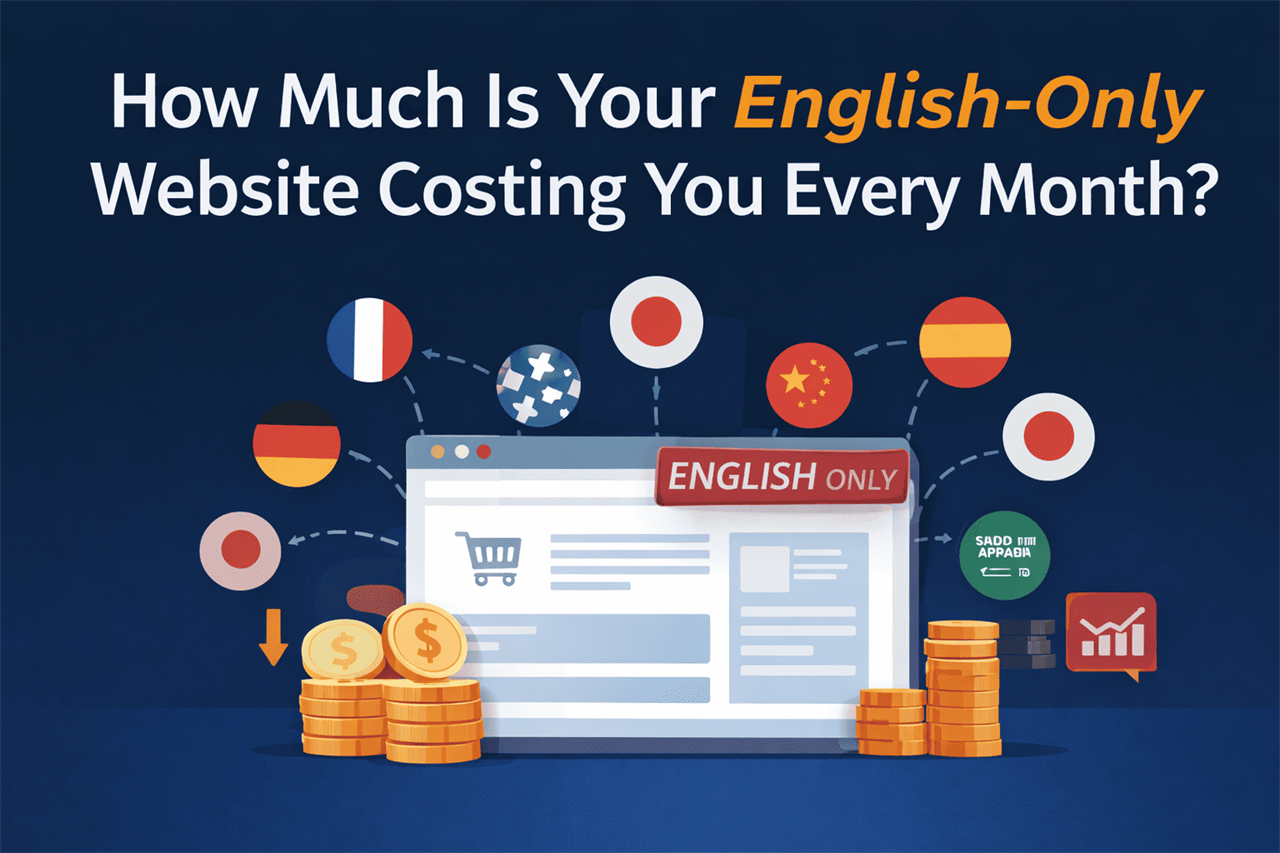
For most businesses, the cost of running an English-only website is never clearly listed. It is not explicitly stated on a quarterly report or show up in a standard marketing audit. It accumulates quietly: in bounce rates that run higher than they should for international traffic, in paid campaigns that generate clicks but not conversions from non-English markets and in customer relationships that erode faster than they otherwise would because the post-purchase experience never speaks to the customer in their own language.
This isn't a niche problem. It's one of the most understated growth bottlenecks in digital commerce today.
The data backs this up clearly. A study by CSA Research shows that 76% of online consumers want to purchase in their native language and 40% will never buy from a website that isn't in their language - even when they understand English well enough to read it. This is important as it's not always about literacy. It's about trust, ease, and a feeling of security. Consumers buy from brands they're comfortable with and language is the primary signal of comfort.
Therefore, the question that every owner and marketing director should be asking is not 'Can we afford to localise?' but 'How much revenue are we losing each month because our website is only speaking to a portion of our audience?'
To quantify the monthly cost of operating an English-only website, it’s worth exploring it from three different perspectives: traffic lost, conversions lost, and customer lifetime value lost.
Google and other search engines display results in the searcher's language. When a search engine user in Germany types in a query in German or a potential customer in Brazil uses Portuguese to find a product or service, an English-only website will not be visible for those searches, even if the product or service would have been a good match.
It is worth considering that 55% of the web's content is currently written in English, and yet only 25% of internet users are native English speakers. The remaining 75% either receive poor service or are served by competitor websites that have already invested in localisation. Every search query in a foreign language that could have brought website traffic, but did not due to language barriers, is lost traffic forever, not just temporarily misplaced.
For a website that averages 10,000 monthly organic visitors, estimates predict a 30-60% increase if localised into only 2-3 languages. With an average e-commerce conversion rate of two percent and a $30 average order value (or around Rs 2,000), that missed traffic could equate to anywhere from $1,200-2,400 (or around Rs 1 lakh to 2 lakh) per month in organic search traffic alone.
This is where the financial impact can become even more severe. A significant percentage of traffic that does reach an English-only website is from abroad. These users arrive on your site (through paid ads, social media, etc.), but find a page that doesn't resonate with them linguistically.
It is widely acknowledged that language barriers are the number one obstacle to international business growth, cited above other reasons like regulatory challenges, tax issues, or cultural differences. Visitors who cannot read product descriptions, navigate T&Cs, or understand the checkout process are never going to convert – no matter the price or brand awareness.
The differences in bounce rates between localised and non-localised pages for the same audience are, in many sectors, 30-50 percentage points. This means if you are spending $500 (or around Rs 50,000) a month on international paid traffic, you could be wasting anywhere between $150-250 (or Rs 15,000-25,000) of that spend on visits that leave without any engagement.
The cost of an English-only website doesn't end at the initial purchase. Customers who communicate with a brand in their native language are more likely to remain loyal, convert more often, and recommend the brand to friends.
A Common Sense Advisory study based on a survey of 8,709 global consumers in 29 countries in Europe, Asia, North America, and South America, CSA Research found that 76% of online shoppers prefer to buy products with information in their native language. In addition, 40% will never buy from websites in other languages.
The logical deduction here is that any customer who doesn't receive personalised communication in their native language will have a lower lifetime value.
Across even a few hundred international clients, this could equate to hundreds of thousands of rupees a year – a recurring and escalating cost that goes unnoticed.
Not all languages present equal opportunities for localisation ROI. Decisions on which languages to prioritise should be based on factors such as existing traffic data, market size, and competition. However, some languages consistently provide strong ROI across industries:
With over 600 million speakers and an e-commerce market expected to grow by 27% annually, it’s the highest potential return on investment for businesses focused on the Indian market. Despite consumer data pointing to this, most Indian B2B and B2C sites are still solely in English.
Over 1.1 billion speakers and the second-largest economy in the world. Mandarin consumers are loyal once trust has been established, and language is the ultimate trust signal.
Official language in 20 countries, with over 480 million speakers. Latin America's digital market is growing quickly and mobile-first users spend more time discovering and browsing products than in North America.
The growing economies of the Gulf Cooperation Council have high online penetration and consumers with the highest average income worldwide.
The European markets provide strong purchasing power and a tendency to prefer communication in their native language. They are among the least likely to complete a checkout in a foreign language.
Each of these markets shares the common factor of a revenue-based decision on localisation, where language is simply the vehicle.
Given the significant opportunities presented, why do many businesses continue to operate English-only websites? The objections they cite are, for the most part, common and well-founded but entirely solvable.
Traditional translation services charge on a per-word basis, which can make it appear cost-prohibitive to localise an entire website. For a 50-page site with 20,000 words translated into 3 languages at typical agency rates, the cost can range between Rs 5-15 lakh. This does not even factor in ongoing content updates.
This cost structure is a remnant of a bygone era. Modern translation technology leverages machine learning and AI, enabling faster translation at a much lower cost, without sacrificing accuracy or brand tone. When combined with professional human review, this is a far more efficient way to achieve high-quality localised content.
Many businesses are concerned about the complexity of implementing and maintaining multiple versions of a site and ensuring content updates are delivered consistently across languages. This was a legitimate issue years ago, but with modern website translation platforms, it's much less so. These tools inject JavaScript on top of your existing site, meaning no changes are needed to your existing CMS, code, or database.
This is arguably the easiest objection to overcome: look at your website analytics! Google Analytics, Hotjar, and even CRMs can segment user data by country and preferred language. The data will almost always show a clear priority market with strong intent that you are currently losing to competitors, simply due to language barriers.
Let’s try to put some real numbers on this for a mid-sized Indian B2B software company with a website that receives 15,000 monthly visitors. Around 30% (4,500 visitors) are from non-English speaking markets, which in this case means predominantly Hindi speakers in Tier 2/3 Indian cities and customers from the Middle East and Southeast Asia.
With a conversion rate of 0.4% on the English-only site, 18 customers are being acquired from that segment per month. If the site were localised, with even a conservative conversion rate of 1.2%, 54 customers would be acquired per month. For a contract value of Rs 25,000, that's a difference of Rs 9 lakh a month in missed revenue, and this doesn't include the benefits of improved search rankings or higher lifetime value.
People always underestimate how much of an advantage a multilingual website offers to your SEO. Using hreflang tags, native language URLs and meta descriptions lets search engines know that you provide content relevant for users in that specific country speaking that language.
This is a huge plus point considering how competitive English language SEO has become. The chances of achieving a high ranking for a specific keyword can be years of work in English, but a matter of months by localizing to Hindi, Arabic or Spanish due to lower competition. Investing in localization early for a specific market gives you a major head start over your competitors.
WebTransAI, by CHL Softech, was developed to overcome the three key barriers to localisation: cost, technical complexity, and quality.
Instead of agency translations, WebTransAI automatically crawls your site for all visible text content – including headings, navigation, forms, and meta descriptions – eliminating the need for manual exports and imports.
The content is then AI pre-translated for all your target languages before going through a structured review console where professional linguists refine the copy. Finally, the localised content is delivered through a single JavaScript snippet, requiring no changes to your existing website architecture.
This means your multilingual website can be live within weeks, at a fraction of the cost, with built-in quality control. The tool is platform-agnostic and works on all web stacks. If you have been putting off localisation due to cost, complexity or brand risk, WebTransAI offers a truly innovative solution.
The cost of an English-only website is not a fixed amount. It depends on your traffic, conversion rates, average order value and target markets. However, for virtually every business with international traffic – which in 2026 is nearly every business with a digital presence – the loss is real and escalating as digital adoption grows in foreign markets.
The question is no longer if you should localise, but when and how well. Those who adapt early will reap the benefits in SEO, customer loyalty and competitive advantage; those who delay will watch their competitors claim these advantages.
We are here to assist with your questions. Write us a message, and we will get back to you shortly.

.png)