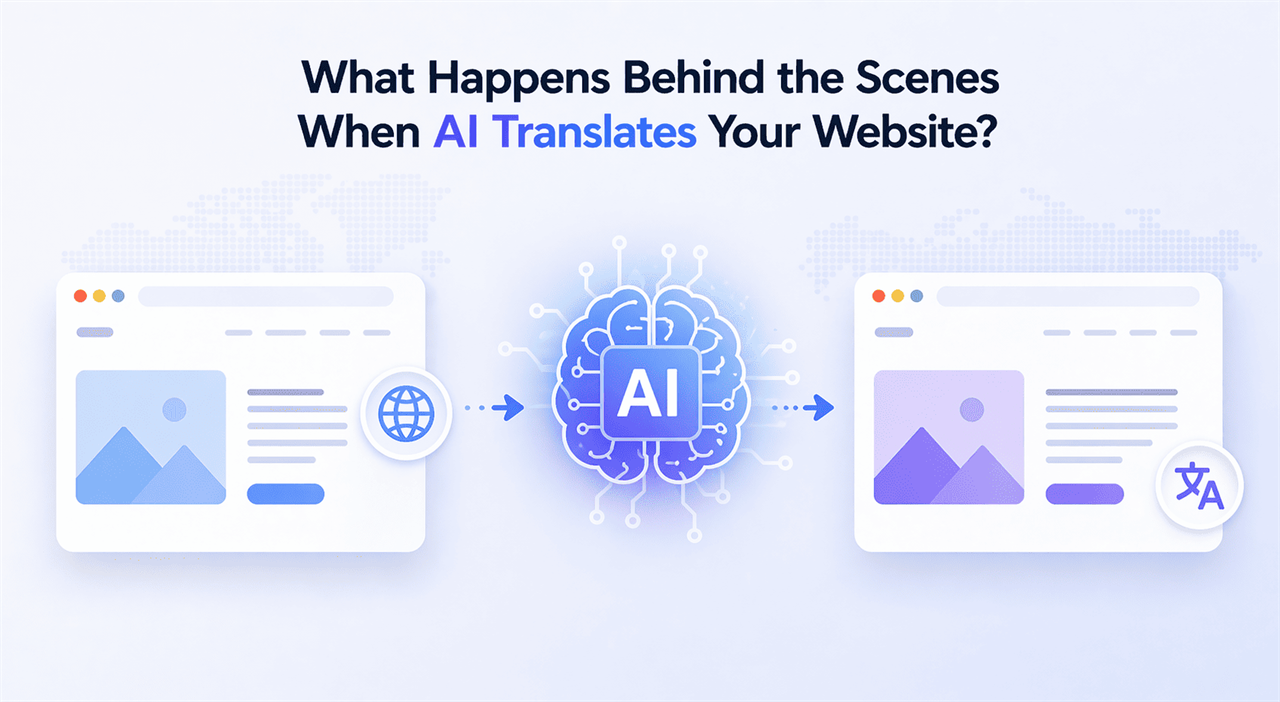
Most people assume AI translation works the way Google Translate does when you paste a sentence into the box. You put text in. Text comes out in another language. Done.
What actually happens when an AI translation system processes an entire website is considerably more involved — and considerably more interesting. Understanding it matters because the quality of what comes out the other side depends entirely on what happens before the translation even begins, especially when you're building a multilingual website designed to perform across markets.
Here is a clear, honest account of what that process looks like.
Before any translation happens, the system needs to know what to translate.
This sounds simple. It is not. A modern website is not a document — it is a layered environment of HTML, CSS, JavaScript, database-driven content, dynamic elements, metadata, and embedded scripts. Some of that should be translated. Most of it absolutely should not.
A well-built AI translation crawler reads the live rendered version of your website — exactly the way a browser does when a real person visits — and extracts only the visible, human-readable content. Headings. Body text. Navigation labels. Button copy. Alt text. Meta descriptions. The words your visitors actually read — the same elements that directly impact your multilingual SEO performance.
What it leaves alone is everything else. The code. The schema markup. The tracking scripts. The backend logic. None of that enters the translation pipeline.
Why does this matter? Because translation memory — the database of approved translations that the system builds over time — only works if it contains clean, consistent source content. If code fragments and untranslatable strings get mixed in, the memory becomes polluted and the system starts producing inconsistent output across pages and update cycles.
Getting the crawl right is not a trivial step. It is the foundation every subsequent stage depends on — and a critical part of scaling a multilingual website efficiently.
Once content has been extracted and segmented — broken into individual units like sentences, headings, and UI labels — the machine translation engine processes each one.
The engine being used matters more than most people realise. Google Neural Machine Translation performs significantly better on Indic language pairs like Hindi, Tamil, and Bengali than most alternatives, due to the depth of training data available for those languages. DeepL tends to produce more natural-sounding output for European languages, particularly German, French, Dutch, and Portuguese, where it has been trained on large volumes of professional text.
A properly built AI translation platform does not lock you into a single engine. It routes intelligently — sending each language pair to the engine most likely to produce the best first draft. That routing decision alone can meaningfully affect how much revision the human review stage requires downstream, and how well your multilingual content strategy holds up across regions.
What the AI produces at this stage is a pre-translation — a fast, structurally sound first draft. It handles grammar, syntax, and literal meaning well. It handles nuance, tone, cultural reference, and brand voice considerably less reliably.
Before the AI drafts a segment from scratch, the system checks whether that segment — or something very close to it — has been translated and approved before.
This is translation memory, and it is one of the most practically valuable features of a serious AI translation workflow.
If a segment is an exact match or a near-match to something already in the memory, the approved translation is served immediately. No AI processing required. No review required. The segment is handled in milliseconds at zero additional cost.
Over time, as more content is reviewed and approved, the memory grows. Match rates increase. The proportion of content that needs to go through the full AI-plus-review pipeline shrinks each cycle. Costs fall. Speed increases. Consistency across the website improves — because the same phrase always translates the same way, every time.
For organisations investing in a multilingual website, this compounding effect is where real scalability starts to show.
Alongside translation memory, a well-configured system maintains a glossary — a locked list of terms that the AI is instructed never to improvise on.
Brand names. Product names. ISO certification designations. Legal and regulatory terminology. Industry-specific phrases with precise meanings.
Glossary enforcement happens at the MT API level — meaning the constraint is applied before the translation is generated, not after. The engine is prevented from treating the term as translatable in the first place.
For any organisation where terminology consistency is a compliance requirement or a brand standard, this is not optional. It is essential for maintaining a credible multilingual brand presence.
The pre-translated content moves into a structured review console where professional linguists — people with domain expertise in the subject matter and the target market — go through the segments and refine them.
They catch the translation that is technically correct but culturally wrong. The phrasing that reads naturally in English but sounds stiff in German. The CTA that works in English but carries an unintended meaning elsewhere.
They also check for brand consistency — whether the translated content still feels like your brand across languages, which is crucial when building trust on a multilingual website.
This is the stage that separates AI translation done properly from AI translation done quickly. The AI creates the volume. The human review creates the quality.
Once content is approved, it does not require a rebuild of your website to go live.
A single JavaScript snippet — added once to the site head — handles everything. When a visitor selects a language, the snippet serves the approved translated content as an overlay on the existing site.
The original pages remain untouched. No new URLs. No CMS migration. No ongoing developer involvement.
When new content is published, the crawler detects it automatically. New segments appear in the review queue. The cycle continues — keeping your multilingual website up to date without operational friction.
Understanding what AI website translation actually involves makes it easier to evaluate whether a platform is doing it properly.
A system that skips the intelligent crawl will pollute its own translation memory. One that uses a single MT engine will create avoidable quality gaps. One with no glossary enforcement will let terminology drift. One with no human review will ship errors at scale.
The output of AI translation is only as good as the infrastructure behind it — especially when your goal is consistent, high-performing multilingual content.
WebTrans AI by CHL Softech is built around this full workflow — DOM-aware crawling, intelligent MT routing, translation memory, glossary enforcement, segment-level human review, and single-snippet deployment.
If you want to see how it handles your website specifically, book a free 30-minute demo. You’ll see the process live — from crawl to translation to delivery — along with real timelines and cost estimates for your content.
We are here to assist with your questions. Write us a message, and we will get back to you shortly.

.png)