Most teams discover AI website translation the same way: someone runs a page through a tool, the output looks surprisingly decent, and suddenly there's a meeting about going multilingual.
Then reality sets in.
The translation quality is fine. The problem is everything around it — how you get content in, how updates stay in sync, how translated pages actually reach users, and whether any of it is crawlable by Google. That's where most AI translation experiments stall, not because the AI failed, but because there was no deployment infrastructure behind it.
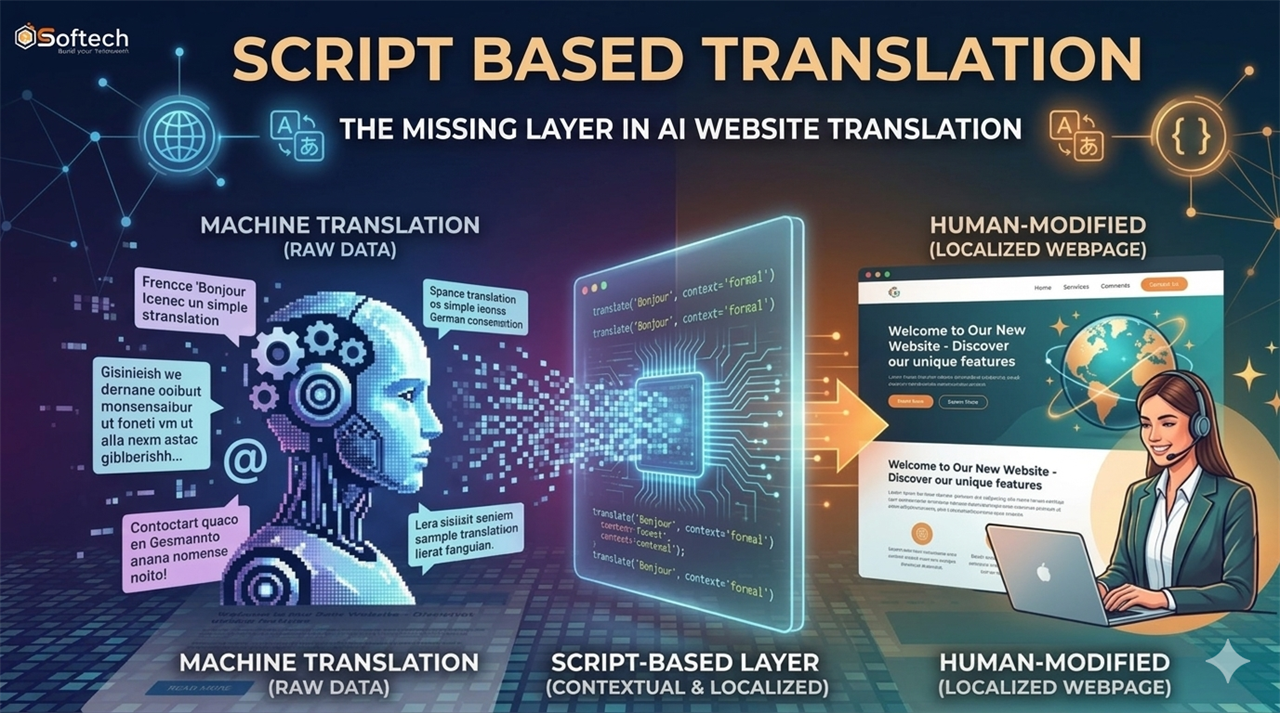
Script based translation is that infrastructure. It's the layer that takes AI-generated translations from "interesting output" to "live, maintained, multilingual website" - without rebuilding your tech stack to get there.
The quality gap between machine translation and human translation has narrowed faster than most people expected. Tools built on large language models can now handle nuance, context, and even brand tone in ways that would have seemed unrealistic five years ago. For a lot of use cases — product pages, blog content, support documentation — AI translation output is good enough to publish with light human review.
But here's the thing nobody talks about enough: getting that translation live, keeping it updated, and making sure search engines can actually read it is a completely separate problem from translation quality.
The old way of handling this was painful even before AI translation existed. You'd export strings, send files around, wait for translations to come back, and then re-integrate everything through your CMS. Now that AI can turn around translations in seconds, the manual deployment process looks even more absurd by comparison. You've solved the slow part, but the broken part is still broken.
Script based translation solves the deployment side. And for anyone serious about scaling AI website translation across multiple markets, that's where the real leverage is.
The concept is straightforward. Instead of managing translation as a separate publishing workflow, you embed a lightweight script into your existing site. That script intercepts page content, passes it through your AI translation engine, and delivers the localized version to each visitor automatically — based on their browser language or an explicit language selection.
When your source content changes, the script based translation layer picks up the new text and processes it without anyone manually triggering a re-export. There's no developer ticket, no file handoff, no waiting. The translation pipeline runs continuously in the background.
A few things this changes in practice:
You stop re-doing work. In a traditional setup, every content update potentially touches the translation workflow. With script based translation, updates to source content flow through to translated versions automatically. The operational overhead per update drops close to zero.
AI and human review can coexist cleanly. One of the better things about script based translation as an infrastructure layer is that it separates the translation step from the review step. AI handles the initial pass. Human reviewers — whether in-house linguists or the client's own team — can validate and adjust within the same platform before anything goes live. You get AI speed without losing the quality gate.
Your site architecture stays intact. This matters more than it sounds. A lot of "multilingual website" solutions require you to duplicate pages, restructure your URL hierarchy, or migrate to a new CMS. Script based translation sits on top of what you already have. The translation layer is additive, not architectural.
Here's a scenario that plays out constantly: a company invests in AI website translation, gets all their pages translated, and then notices their international traffic looks exactly the same as before they did any of it.
The issue is usually rendering. Client-side JavaScript translation — where the page loads in the source language and then gets swapped out by a script — is largely invisible to search engine crawlers. Googlebot sees the English version. It doesn't index the French or German version. All that translation work generates zero organic visibility in those markets.
Script based translation deployment that's built for SEO handles this differently. The translated content is either served server-side or injected in a way that remains crawlable. Hreflang tags are implemented correctly. Each language version gets its own indexable URL structure. The translated pages can actually rank.
For anyone using AI website translation as part of an international growth strategy — not just a nice-to-have feature — this distinction matters enormously. Translation without indexability is basically an operational cost with no search upside.
There are a lot of lightweight translation plugins and widgets out there, and they work fine for simple cases. But they tend to hit the same set of walls once you start scaling:
No content versioning, so when something goes wrong with a translation, rolling back is a manual nightmare. No real integration with AI translation pipelines, so you're copy-pasting output rather than connecting systems. Limited or zero SEO consideration, for the reasons above. And almost no support for the human review step, which is where translation quality actually gets locked in before pages go live.
Script based translation as a purpose-built deployment layer addresses all of these. It's not a widget bolted onto an existing site — it's a translation infrastructure that happens to integrate with AI engines rather than replacing human translators outright.
There's a difference between a proof of concept and something you'd actually trust to run multilingual content across your site indefinitely. A few things separate the two:
Continuous content syncing. New pages, updated copy, and structural changes to the site should be picked up automatically by the script based translation layer — not flagged for manual re-processing.
AI engine flexibility. The best setups aren't locked to one translation engine. You want the option to route different content types through different models — or to swap engines entirely if something better comes along — without rebuilding your deployment infrastructure.
Crawlable output. As covered above, the translated content needs to be indexable. This isn't negotiable if SEO matters to you, and it usually does.
A real review workflow. Even with strong AI translation output, there are strings that need human judgment — brand-specific terminology, legally sensitive language, content that varies meaningfully by market. Script based translation platforms that include a review layer let you flag, edit, and approve at the string level rather than re-exporting entire files.
Rollback at the version level. Translation errors happen. A version control system inside the script based translation platform means you can revert a language to a previous state quickly, without touching the source site.
At CHL Softech, the thing we kept running into was companies that had figured out the AI translation part but had no good answer for deployment. They were doing solid work on translation quality and then losing most of the value in a manual, slow, SEO-blind publishing process.
WebTrans AI is built around script based translation as the core delivery mechanism. Sites get crawled automatically, AI handles the initial translation pass, and content goes through human review — by professional linguists or the client's internal team — before anything goes live. The translated content is deployed in a way that's fully crawlable, correctly tagged for international
SEO, and automatically updated when source content changes.
The goal is that script based translation stops being an infrastructure problem your team has to maintain and starts being a background layer that just runs — the same way your CDN runs, or your analytics does. Set up once, continuous from there.
AI website translation has removed the biggest bottleneck in going multilingual — the time and cost of producing translated content. What's left is the infrastructure question: how do you deploy it reliably, keep it updated, and make sure it actually drives results in international markets?
Script based translation is the answer to that question. Not as a shortcut, but as a proper deployment layer for AI-generated translations — one that handles the ongoing operations, SEO requirements, and quality control that a production multilingual site actually needs.
If you're already working with AI website translation and running into deployment friction, that's exactly the problem script based translation is built to fix.
We are here to assist with your questions. Write us a message, and we will get back to you shortly.

.png)