Software has never been easier to get your hands on. A business can subscribe to a CRM in the morning, configure an HRMS by afternoon, and have a project management platform running before the day ends.
SaaS looks like the obvious answer. Fast to deploy, easy to start with, and no technical headache. And for a long time, that simplicity is exactly what makes it work.
But as companies grow, a pattern starts to emerge. Convenience has a long-term price — and at some point, the math stops working in your favor.
The question today isn't whether SaaS works. It does. The real question is whether it remains the smartest investment once your operations start getting complex.
There's a reason SaaS dominates business software.
You get started without a heavy upfront investment. The vendor handles updates, hosting, maintenance, and security. Your team focuses on actual work instead of managing IT infrastructure.
For startups and small teams, this makes complete sense. A subscription to a CRM, an inventory system, or an accounting platform can have a business up and running almost immediately.
The trouble starts when those subscriptions multiply.
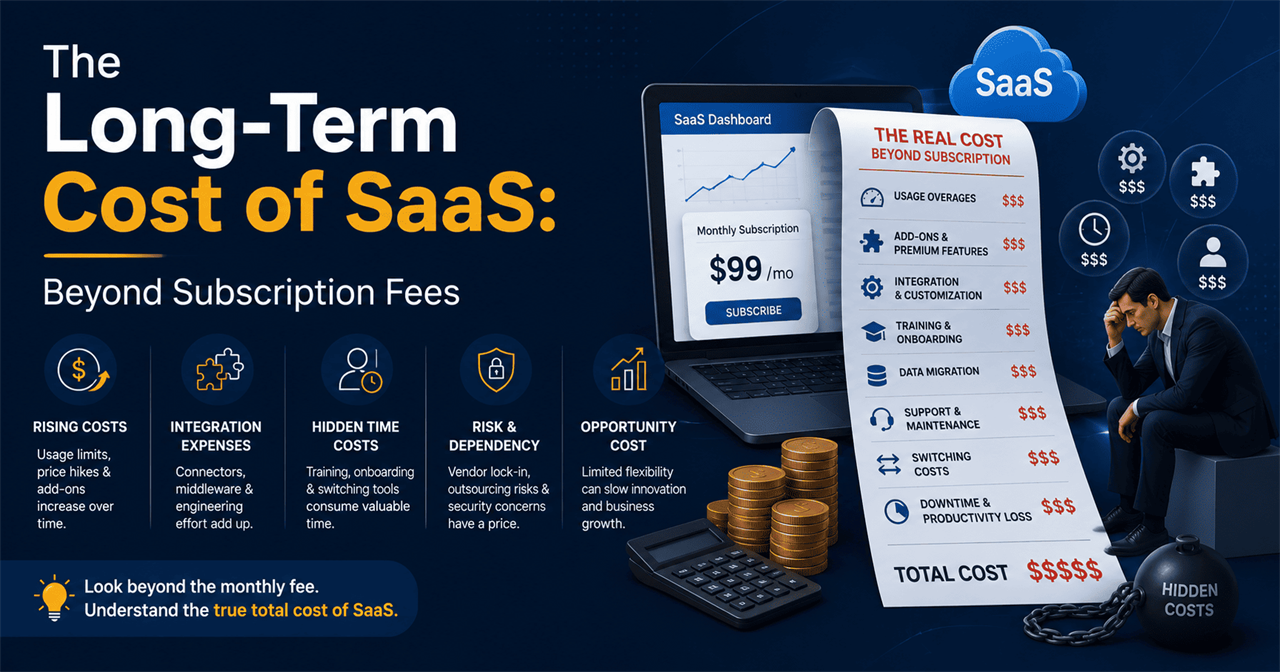
A CRM for sales. An ERP for operations. A finance platform. An HRMS. Reporting tools. Automation tools. Integration middleware. Each one seemed reasonable when it was added. Together, they quietly become a significant recurring cost.
Most SaaS products are built around recurring revenue. As your business grows, your software bill tends to grow with it.
Need more users? Upgrade your plan. Need advanced reporting? Upgrade your plan. Need additional features, better integrations, or expanded automation? Upgrade your plan.
At a certain scale, you're no longer just paying for software. You're paying for every additional layer of functionality your operations require — and that number keeps climbing.
For many organizations, the annual software spend eventually crosses a threshold. What they're paying in subscriptions exceeds what it would have cost to build something tailored specifically to how they work. Businesses are increasingly asking whether a fully owned operational platform can do everything their current SaaS stack does — without the recurring bill.
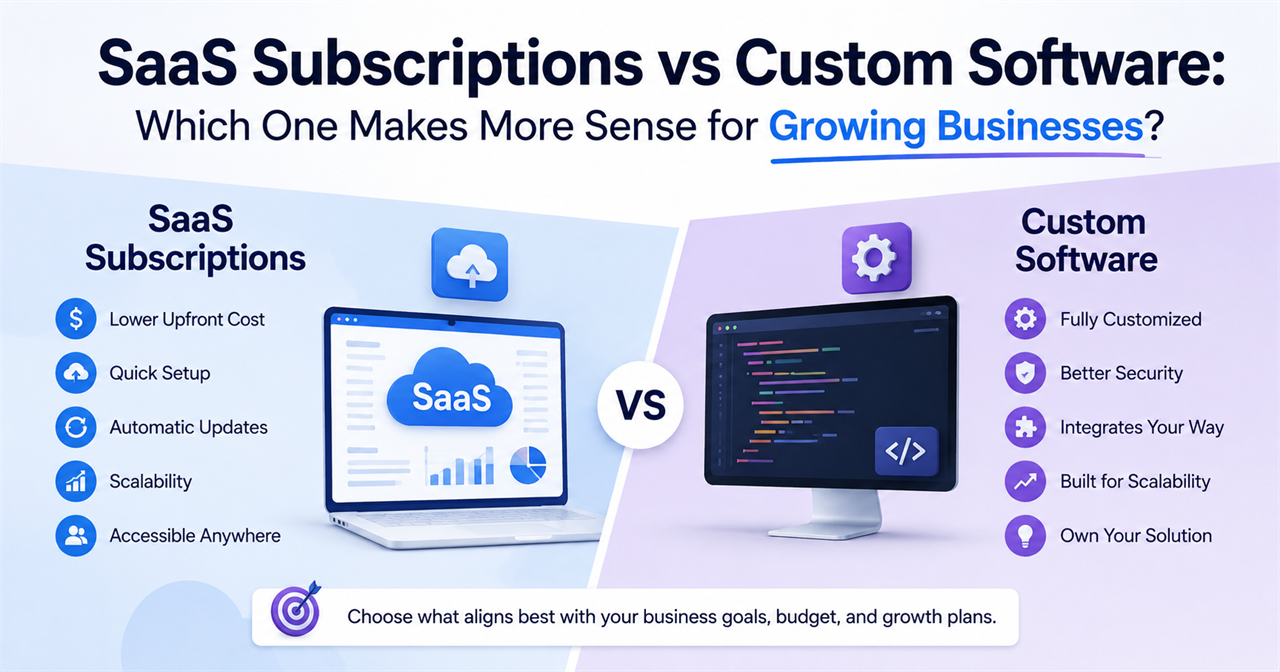
With off-the-shelf software, your business adapts to fit the product. With custom software, the product is built around your business.
Your workflows, approval chains, reporting requirements, and operational structure become the foundation. Nothing is retrofitted. Nothing needs to be worked around.
This matters especially for businesses whose operations have moved well beyond standard templates. Manufacturing companies, logistics providers, staffing firms, healthcare organizations, and service businesses often develop workflows that packaged software simply isn't built to handle. In those situations, customization stops being a nice-to-have. It becomes a genuine competitive edge.
At CHL Softech, custom software development and process automation solutions are designed around how your business actually operates — not around what a vendor's platform was built to support.
Businesses looking for a broader view of what this can include can also explore Softech's full range of products and services built for process-driven organizations.
There's one aspect of this decision that doesn't get enough attention: ownership.
With SaaS, you're renting access. The vendor owns the platform, controls the product roadmap, and sets the pricing. If costs go up, your options are limited — pay more or go through the pain of migrating to something else.
Custom software changes that relationship entirely.
The platform belongs to your business. The workflows belong to your business. Infrastructure decisions are yours to make. And most importantly, the software evolves according to your priorities — not a vendor's quarterly roadmap.
That level of control becomes more valuable with every year you scale.
There's no single right answer.
If you're a small team that needs to move fast, SaaS is often where you should start. It gets you operational without friction.
But if you're managing a stack of subscriptions, dealing with rising software costs, running specialized workflows, or simply wanting more control over the technology your business depends on — custom software becomes a serious option worth evaluating.
The decision shouldn't be based only on what your business needs today. It should be based on where you'll be three to five years from now.
SaaS wins on speed and accessibility. Custom software wins on ownership, scalability, and long-term control.
The businesses pulling ahead aren't just using more software — they're using software that's built around how they work.
If rising subscriptions, vendor dependency, and workflow limitations are starting to hold you back, it may be time to look at a platform built specifically for your business.
Learn more about CHL Softech's experience building business-critical software for organizations across industries.
The best software investment isn't always the easiest one to start with. More often, it's the one that gives your business the greatest control, flexibility, and value over time.
We are here to assist with your questions. Write us a message, and we will get back to you shortly.

.png)