.png)
ERP had a good run. For a long time, it was the answer when businesses asked how they could get organized, stay consistent, and understand what was happening across finance, inventory, procurement, and production.
That remains true to a large extent. ERP systems are not going away, and they shouldn't. But the honest reality is that the businesses running on ERP alone without anything connecting it to the wider way they operate—are starting to feel the friction. Not catastrophically. Not all at once. Just a slow, persistent drag that makes everything slightly harder than it needs to be.
The problem isn't ERP. The problem is that business has changed, and most ERP systems were not built for the way businesses actually operate in 2025.
ERP systems were a genuine leap forward when they first became mainstream. Before them, companies ran on spreadsheets, disconnected databases, and institutional memory. Bringing finance, inventory, procurement, and supply chain into one structured system meant businesses could finally see what was happening and make decisions based on actual data.
For manufacturing businesses especially, ERP delivered obvious value: production planning tied to inventory levels, procurement linked to demand forecasts, and financial reporting pulled from live operational data. That kind of structure still matters, and for companies with straightforward operational models, ERP continues to do the job.
But the baseline has shifted. The average mid-sized company in 2025 isn't just running one production line or selling through one channel. They're managing customer journeys across digital and physical touchpoints, coordinating distributed teams, handling approval workflows that involve multiple departments, and trying to make fast decisions with data that lives in five different systems.
ERP was built for a different operational reality. It organized transactions well. It was not designed to connect an entire business ecosystem.
The issue isn't that ERP breaks. It's that everything around it starts requiring its own tool, and those tools don't talk to each other cleanly.
Most businesses today run on a stack that includes some combination of CRM, HRMS, project management software, analytics platforms, industry-specific applications, and workflow automation tools. Each was chosen because it solved a real problem. Collectively, they create a new problem: fragmentation.
Here's where this actually hurts:
Data is everywhere but insights aren't
Sales have customer data in the CRM. Operations track execution in ERP. HR manages headcount in HRMS. Finance maintains its own reporting environment. None of these are wrong choices. But when a decision-maker needs a clear picture of operational performance, someone has to go manually pull from four systems, reconcile what doesn't match, and hope the export was recent enough to be useful.
That process — not the lack of data — is what slows businesses down. By the time you've assembled the picture, it's already slightly out of date.
The business bends to fit the software
Off-the-shelf software is built for the median use case. That's fine for companies whose operations look like the media. For everyone else, there's a quiet negotiation that happens: the business slightly adjusts its workflow to match the software's predefined process.
Over time, this shows up as spreadsheets maintained alongside the official system, manual approval steps that work around software limitations, and operational knowledge that lives in people's heads because the system can't hold it. The workarounds pile up, and eventually the workarounds become the process.
Growth adds complexity faster than the systems can handle it
Companies often start lean—a basic CRM, accounting software, an inventory tracker. Those tools work fine until the business doubles. Then double again. Then opens another division or acquires a partner. At some point, the team spends more time managing the tools than running the business. Data entry happens twice across systems. Different teams are working off different versions of the same information. End-to-end visibility across a single process requires piecing together reports from three platforms.
This is a solvable problem, but only if it's addressed before the complexity becomes structural.
The term gets used loosely, so it's worth being precise about what makes an integrated operations platform different from simply adding another tool to the stack.
The distinction isn't about features. It's about architecture and intent.
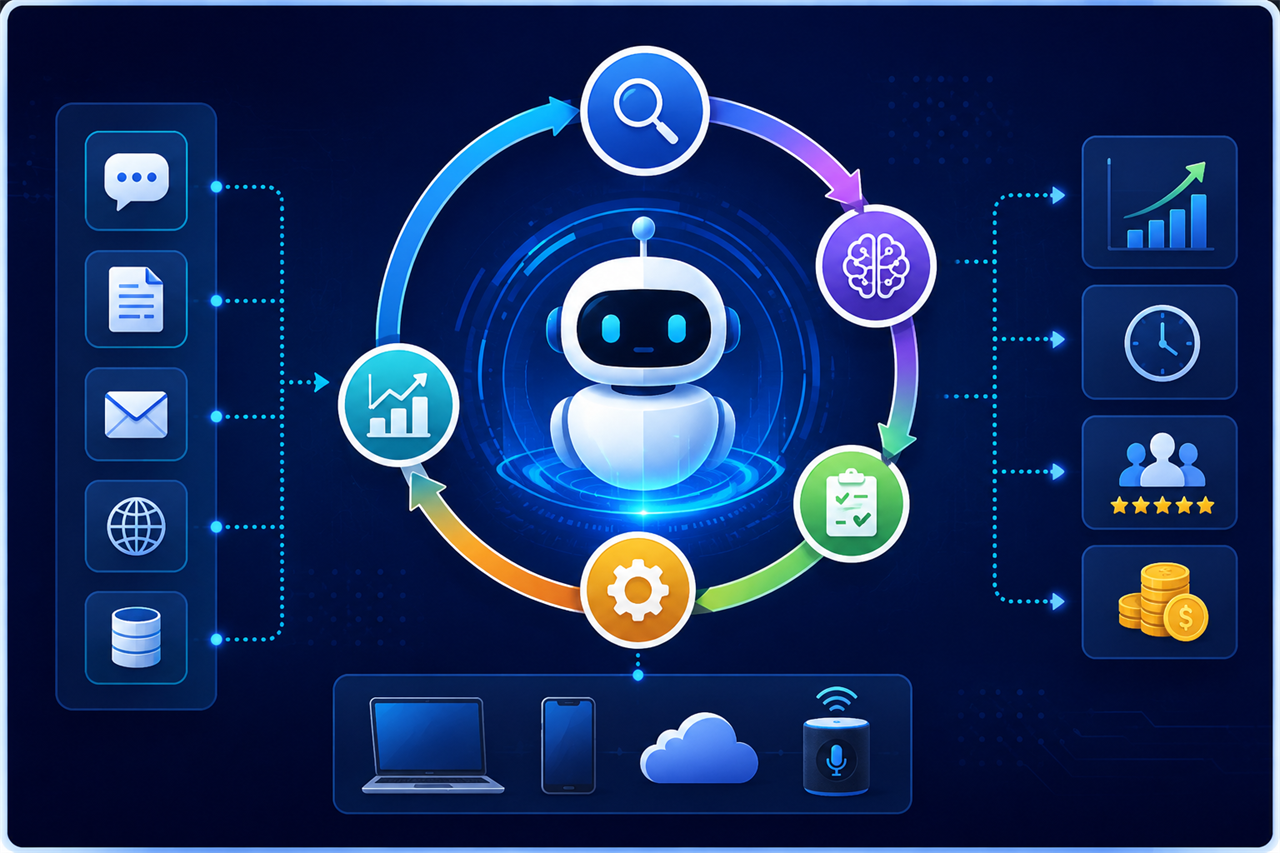
An ERP system records what happened. An integrated operations platform coordinates what happens next. It connects workflows across functions — not just stores data for each one. Rather than each department managing its own system and sharing data via exports and integrations, an operations platform creates a unified layer that links how the business actually runs.
In practice, depending on the business, this might connect:
• Sales pipeline data with production scheduling
• HR and workforce capacity with project delivery timelines
• Procurement triggers with inventory thresholds and supplier workflows
• Approval processes that span finance, operations, and leadership without leaving the platform
• Analytics and reporting that pulls from live operational data, not yesterday's export
The other defining feature is that the platform is built around how the business actually operates—not a generic process structure the business has to map itself onto. This matters most for companies with non-standard workflows, multiple business lines, or operational models that don't fit neatly into category templates.
This is a question worth addressing directly, because a lot of the confusion in this space comes from vendors positioning integrated platforms as ERP replacements.
They usually aren't. For most businesses, the right answer isn't replacing ERP — it's extending it. ERP continues to handle what it does well: structured financial control, procurement, inventory management, and compliance reporting. The integrated platform sits above and around it, connecting ERP data with the wider operational ecosystem and handling the coordination logic that ERP was never designed for.
The clearest way to think about it:
• ERP manages core transactions and records
• An integrated operations platform manages business execution—the how, who, when, and what-next that ties transactions together into outcomes
For manufacturing businesses, this distinction is particularly relevant. A production delay doesn't just affect inventory records in ERP. It cascades into workforce scheduling, customer commitments, procurement timelines, and cash flow. An integrated platform creates visibility across that entire chain—and can trigger the right responses across functions without manual coordination.
There's rarely a single moment when businesses realize they've outgrown their current stack. It accumulates gradually. Some of the most consistent signals:
• The same data gets entered more than once across systems
• Decisions slow down because assembling accurate information takes too long
• Teams operate on different versions of operational truth
• End-to-end process visibility requires manual reconciliation across platforms
• New business requirements consistently hit the wall of what the current setup can accommodate
• Operational knowledge is held by individuals, not systems—and leaves when people leave
Any one of these is manageable. Several of them together are a pattern worth taking seriously.
The shift toward integrated operations platforms isn't about chasing new technology. It's a practical response to how business complexity has grown. Companies aren't struggling because their teams aren't good enough or their ERP is broken. They're struggling because the operational infrastructure underneath doesn't reflect how the business actually works anymore.
Getting ahead of that requires an honest look at where the friction is coming from. Usually, it's not in the core systems — it's in the gaps between them. The handoffs that require emails. The approvals that live outside the system. The reports that need someone to pull them manually.
An integrated operations platform doesn't eliminate the need for ERP. It doesn't replace the specialized tools that do specific jobs well. What it does is create a layer of connective tissue that makes all of them work as one operating environment rather than a collection of separate solutions.
That's a meaningful difference — especially for businesses that plan to scale, evolve, or simply operate with more speed and less internal friction than they do today.
What is the difference between an ERP system and an integrated operations platform?
ERP systems are built to manage core business transactions — finance, inventory, procurement, and production. Integrated operations platforms are designed to connect the full operational workflow across departments, including processes that ERP doesn't cover. In many cases, they work alongside ERP rather than replacing it.
Do businesses need to replace their ERP to use an integrated operations platform?
Not usually. Most integrated operations platforms are designed to work with existing ERP investments, extending them rather than replacing them. The platform connects ERP data with CRM, HRMS, analytics, and other operational tools to create a unified view of the business.
Which types of businesses benefit most from integrated operations platforms?
Businesses with complex operational models, multiple departments or divisions, non-standard workflows, or significant growth in the past few years tend to see the clearest benefit. Manufacturing companies are a strong example, but the same challenges apply across logistics, professional services, and any organization managing multi-step processes across multiple teams.
How is an integrated operations platform different from just adding more integrations between existing tools?
Point-to-point integrations between tools solve specific handoff problems but don't address the underlying fragmentation. An integrated operations platform is designed from the start as a unified operational layer—the goal is a single environment where workflows, approvals, data, and coordination happen together, rather than a set of pipes connecting separate systems that still operate independently.
What should a business look for when evaluating an integrated operations platform?
Flexibility to reflect the business's actual workflows rather than forcing process standardization; genuine connectivity with existing tools, including ERP and CRM; clear visibility across operational functions; and the ability to scale with the business as it grows. The platform should reduce manual coordination, not create a new layer of complexity.
We are here to assist with your questions. Write us a message, and we will get back to you shortly.