Most leadership teams today don’t suffer from a lack of data. They suffer from a lack of usable truth.
Dashboards are full. On-time reports can be generated that contain employee count, employee turnover percentages, attendance, and performance ratings. However, when leaders make decisions regarding employees—such as employee retention, the pace of hiring, restructuring, and employee productivity—they have limited access to human resources data, which can help with their decision-making. So, leaders' instinct provides the basis for their people's decisions.
This lack of accessibility of human resources data, compared with the ability of leaders to make effective decisions from that data, is not an accident; it's a matter of design.
Human resource data has never been created for use in helping leaders with their people decision-making. HR systems were created to document events, rather than provide an explanation for those documents.
Attendance systems tracked presence. Payroll systems calculated salaries. Performance tools stored ratings. Engagement surveys are captured once or twice a year. Each system did its job in isolation. None were designed to tell a cohesive story.
As a result, leadership sees outputs, not patterns. A spike in attrition is visible, but the early signals that led to it are not. A drop in productivity is noticed, but its relationship to workload, leave behavior, or team churn remains unclear.
Data exists, but it doesn’t connect. And disconnected data rarely leads to confident decisions.
One of the most common misconceptions in organizations is equating reporting with analysis.
HR teams often spend significant time generating reports for leadership. Monthly attrition numbers. Department-wise absenteeism. Quarterly performance distributions. These reports are accurate, but accuracy alone doesn’t make them useful.
Leadership decisions require context:
When HR data is presented as static snapshots rather than evolving patterns, leaders are forced to interpret without sufficient depth. Decisions then become reactive instead of preventive.
In many organizations, HR data lives across multiple tools that don’t speak to each other.
Attendance data sits in one system. Performance feedback in another. Learning data somewhere else. Engagement surveys are often handled externally. Managers operate on spreadsheets. HR consolidates manually.
By the time data is brought together, it’s already outdated. More importantly, the relationships between data points are lost.
For example:
Leadership cannot see the reality of their relationship with HR when they have fragmented HR systems. They only see signs of the issues instead of the root causes.
The deterioration of trust in HR data by leadership over time occurred not because of mistakes, but rather due to incomplete information. Leaders lose faith in HR data when there is no clear understanding of how to utilize those data sources for business decisions. So they fall back on gut feelings and stories instead of facts. Once this occurs, HR becomes a function to provide data and no longer a strategic business partner.
As this relationship erodes, it is slow but ultimately harmful. Once leaders choose to stop using HR data to make decisions, many of the best findings are destined never to be seen.
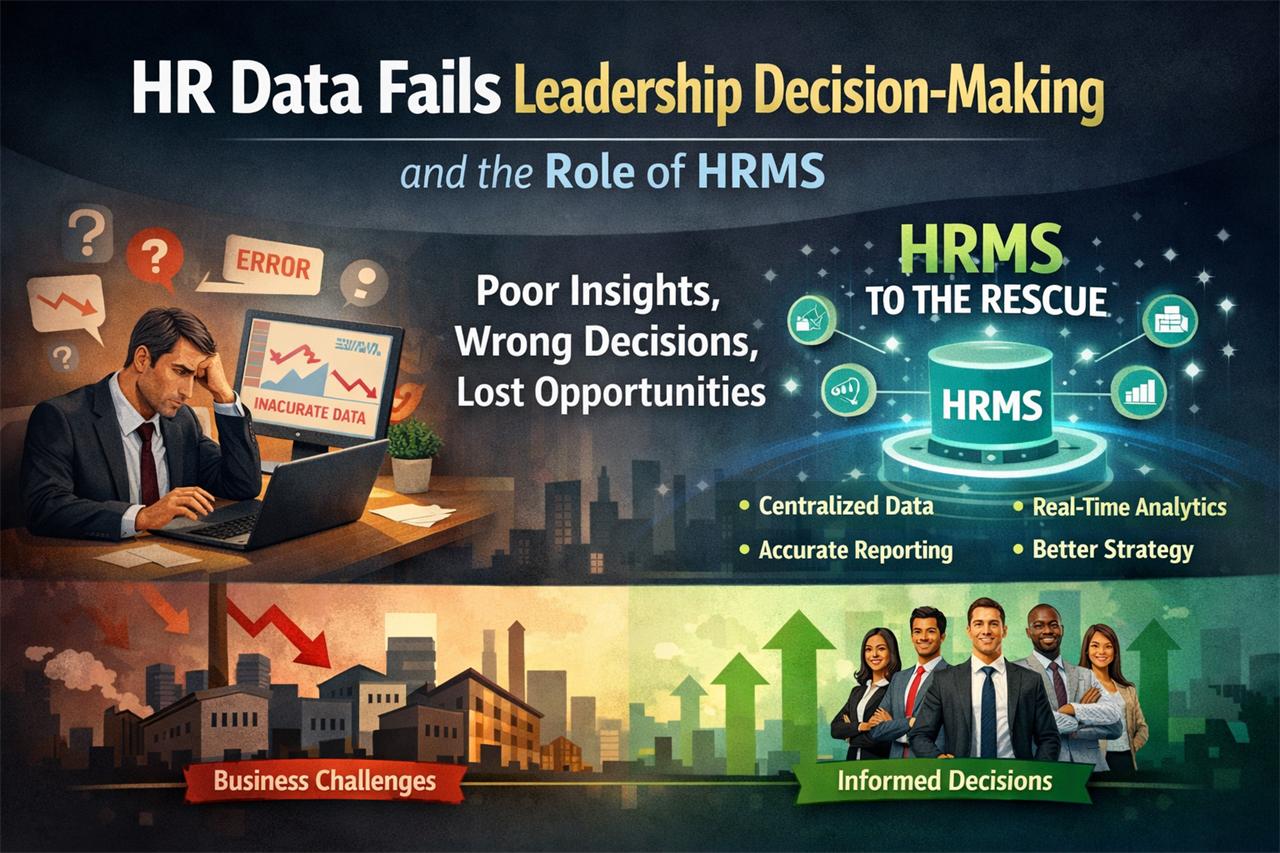
This is where modern HRMS changes the conversation.
A well-designed HRMS is not just a system of record. It is a decision infrastructure.
By integrating core HR functions into a single ecosystem, HRMS enables:
Instead of asking HR to explain outcomes after they occur, leadership can start seeing indicators while there is still room to act.
Most HR data today focuses on lagging indicators. Attrition rate after people leave. Engagement score after surveys close. Performance ratings after cycles end.
HRMS allows organizations to shift toward leading signals:
Individually, these signals may seem minor. Together, they form a story. And stories are what leaders need to make decisions with confidence.
When HR data is structured, connected, and timely, leadership conversations change.
Instead of:
“Why did attrition increase last quarter?”
The question becomes:
“Which teams are showing early risk, and why?”
Instead of:
“Are people disengaged?”
The question becomes:
“What behaviors indicate disengagement, and where is it emerging?”
HRMS doesn’t replace leadership judgment. It sharpens it. It allows decisions to be grounded in evidence rather than hindsight.
For HR to truly influence leadership decisions, the function must move beyond reporting and towards interpretation. That shift is impossible without the right HR systems in place.
HRMS is not about digitizing HR tasks. It is about enabling organizations to understand their workforce as a living system, not a set of static records.
When HR data works, leadership doesn’t need more reports. They gain clarity. And clarity is what drives better decisions.
We are here to assist with your questions. Write us a message, and we will get back to you shortly.

.png)