For many years, AI was seen almost exclusively in fiction, research papers and tech conferences - which the common populace was likely unaware of. Presently, however, AI is prevalent in virtually every aspect of our daily lives through many subtle ways. On a daily basis, we use AI to perform tasks like waking you up in the morning, providing directions while driving to several destinations, filtering out spam emails, suggesting movies based on user reviews and even completing your message to someone on your behalf.
AI is an integral part of our daily lives; therefore we have a lot to gain from the extensive application of AI in many industries, thus creating multiple opportunities. AI in daily life isn’t arriving with fanfare. It’s blending in. And when something becomes invisible, it becomes powerful.
Rather than viewing AI as an intangible idea that may or may not materialize in the future, let’s take a look at what AI is doing for us in the here-and-now and whether or not there are risks of harm to people if we lose sight of these benefits.
If you ask most people whether they “use AI,” many will say no. Then they’ll unlock their phone with Face ID, open a maps app, scroll a social feed curated by algorithms, and pay a bill flagged as safe by fraud detection software.
This is the quiet part of the story.
AI didn’t enter our lives through one big moment. It slipped in through convenience. One helpful feature at a time. Spam filters that actually worked. Search results that felt smarter. Recommendations that saved time. Slowly, artificial intelligence in everyday life stopped feeling like technology and started feeling like infrastructure.
What’s different now is how accessible it is. Tools that once required massive budgets are now available to freelancers, students, small businesses, and creators. Writing help, image generation, fitness tracking, budgeting apps, smart calendars. All of these are AI applications in daily life, even if we don’t label them that way.
This normalization is shaping the future of AI technology into something practical, almost boring. And that’s where its real influence begins.
When AI is useful, it doesn’t try to impress you. It just reduces friction.
In healthcare, AI helps doctors read scans faster, notice patterns earlier, and manage overwhelming amounts of data. It doesn’t replace medical judgment, but it gives professionals more breathing room to focus on patients instead of paperwork. For someone waiting on a diagnosis, that time matters.
In education, AI driven platforms adjust lessons based on how a student actually learns. Not everyone processes information the same way, and traditional classrooms often struggle to accommodate that. When used thoughtfully, AI can support students who might otherwise fall behind or disengage.
At home, AI quietly handles things we don’t want to think about. Optimizing energy usage. Reminding us when appliances need maintenance. Suggesting meals when we’re tired and staring into the fridge with no ideas. These aren’t life changing moments on their own, but they add up.
At work, AI in daily life shows up as small reliefs. Drafting first versions of documents. Summarizing long meetings. Pulling insights from messy data. Answering routine customer questions. The real value isn’t speed. It’s mental space.
Future advancements in artificial intelligence will shift focus from making machines smarter to making systems aware of their context.
Artificial Intelligence is likely to respond to patterns instead of just reacting to commands. The patterns will not be responded to in an eerily omniscient manner; rather, they will be used in pragmatic and beneficial ways. For example, if you have had a large number of meetings booked on your calendar for a sustained period, the calendar could automatically suggest some time away from meetings in order to give you a proper respite. A health app may lower activity targets during stressful periods rather than pushing harder.
At home, systems will adjust to routines without being told. At work, AI will function more like a thoughtful assistant than a tool you constantly manage. It will help organize chaos, not add to it.
This shift is central to AI trends 2026. The excitement won’t come from flashy demos. It’ll come from reliability. From tools that quietly work, respect boundaries, and don’t demand constant input.
Here’s where the conversation needs honesty.
AI applications in daily life rely on data. A lot of it. Where we go. What we buy. What we search. How long we pause on a screen. Over time, this creates detailed digital versions of ourselves.
At its core, privacy is about your ability to control your data. Most people do not completely understand what information is collected about them, how long it will be kept, or who it is shared with. Once you lose trust in companies with that data, there is very little hope of getting it back.
There is also an issue of over-reliance on AI technology. When you have an AI system that tells you where to go, what to buy, how to respond and what decisions to make, it becomes easy not to question the outcome. Most of the time, this is ok, but there will be times when that’s not. Systems can be wrong. They can miss nuance. They can simplify situations that need human judgment.
Bias is another issue we can’t brush aside. AI learns from existing data, and that data reflects real world inequalities. If those patterns aren’t actively corrected, bias doesn’t disappear. It scales. Quietly.
Few topics create more anxiety than AI and jobs. And honestly, the fear isn’t irrational.
AI will change work. Some tasks will disappear. Others will change shape. But history shows that technology rarely removes work entirely. It reshapes it.
The real risk isn’t replacement. It’s unpreparedness.
As we grow closer to fully utilizing the capabilities of artificial intelligence (AI) in our everyday lives, the demand for workers with critical thinking, agility, and the ability to collaborate with intelligent tools will only increase. The importance of communication, creativity, ethical judgment and problem-solving abilities will begin to eclipse those individuals who possess a good memory of procedures.
AI should handle repetition. Humans should handle meaning. If we design systems with that balance in mind, AI becomes a partner rather than a threat.
As artificial intelligence in everyday life becomes unavoidable, responsibility has to keep pace.
That means clear rules around data usage. It means systems that can explain decisions, not hide behind complexity. It means knowing who is accountable when something goes wrong.
Regulation isn’t about slowing innovation. It’s about protecting trust. Without trust, even the most powerful technology becomes useless.
The companies building AI, the governments regulating it, and the people using it all share responsibility here. This isn’t someone else’s problem.
Looking at AI trends 2026, one thing is clear. AI will fade further into the background. It will feel less like software and more like a layer beneath daily life.
People, however, will become more aware. More selective. Less impressed by novelty and more interested in transparency. Tools that respect privacy and explain themselves will win trust.
The future of artificial intelligence won’t be defined by how advanced it becomes, but by how well it fits into human values.
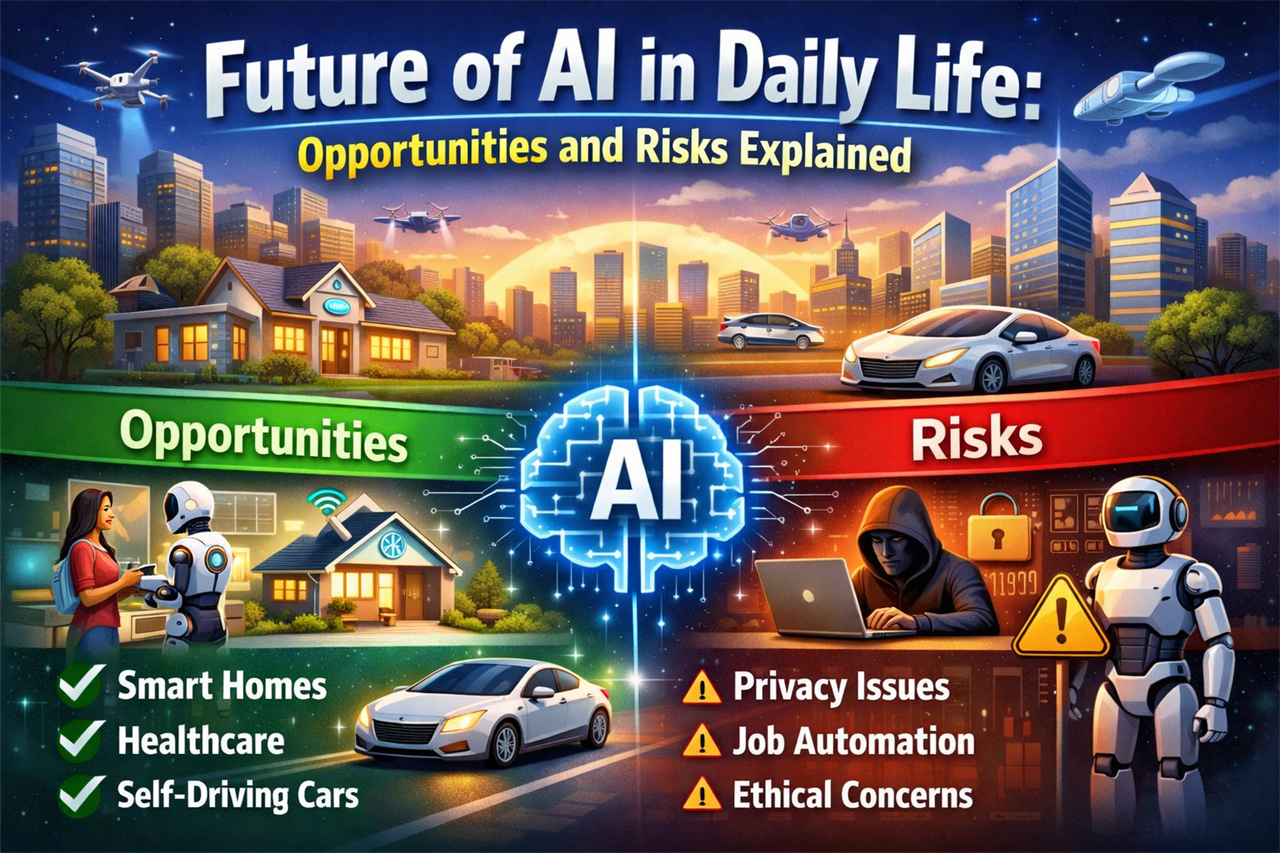
AI in daily life is already here. It’s shaping routines, decisions, and expectations, whether we notice it or not. The opportunities are real. Better healthcare. Smarter learning. Less wasted time. The risks are real too. Privacy loss. Bias. Over-dependence.
The distinction between advancement and regret lies in the equilibrium between them. In order for artificial intelligence to create an improvement in quality of life, we need to treat it as a resource and not simply an entity that we must listen to without question. Therefore, the development and growth of artificial intelligence will not just happen to us; we will proactively create through our ongoing daily decisions. Finally, thoughtful decision making will provide us a sense of control over the use of artificial intelligence and allow us to avoid feeling taken over by it. It’ll feel like support, done right.
We are here to assist with your questions. Write us a message, and we will get back to you shortly.

.png)