Over the last few months, conversations with prospective HRMS clients have followed a common trend:
I spent 11 hours on the last day of the month fixing payroll errors before salaries could go out.
Eleven hours..
Fixing mistakes that software should have caught in seconds.
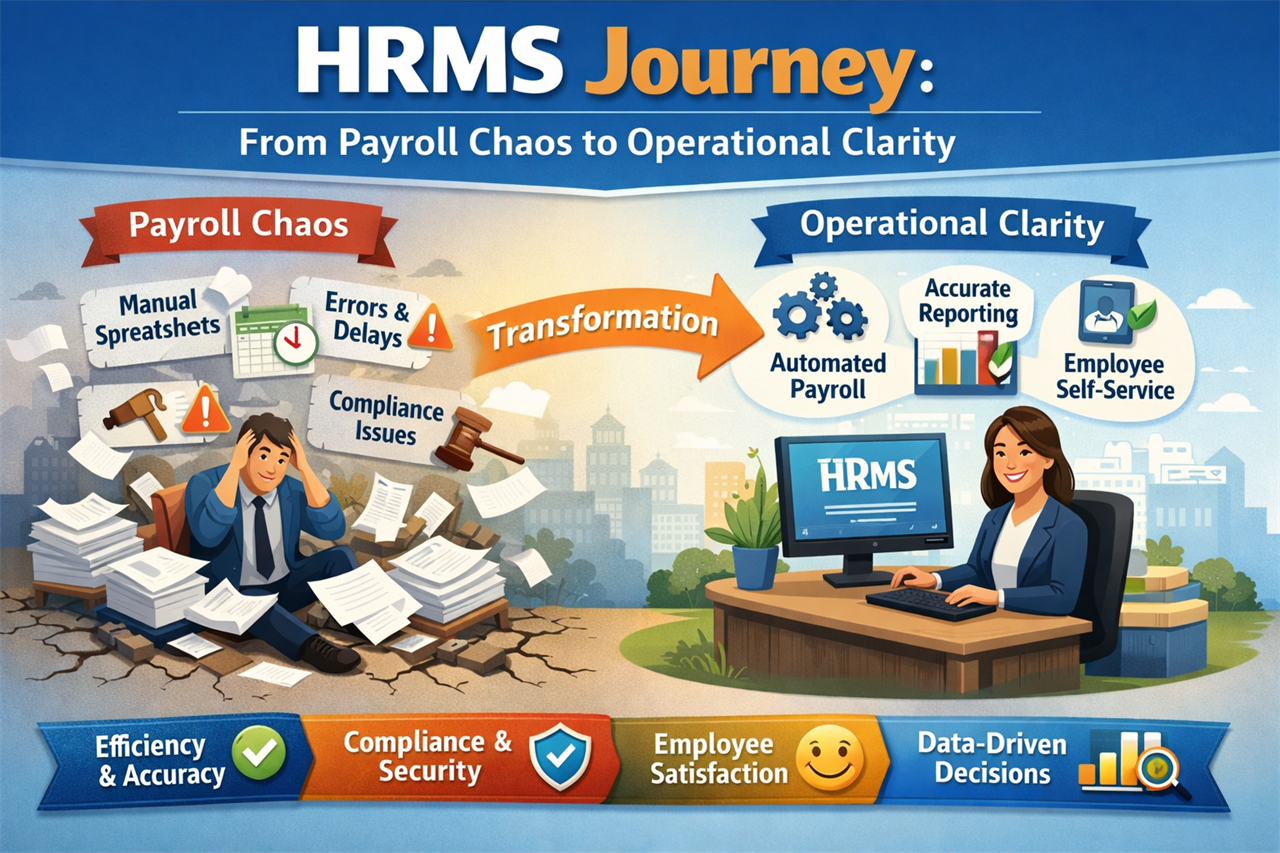
This isn’t rare. From Bengaluru to Delhi, from bootstrapped startups to 500 employee manufacturing units, HR teams across India are chasing attendance registers, manually calculating PF, ESI and TDS, reconciling leave balances at the end of the month, hoping payroll closes without crisis.
The issue isn’t capability. Its adaptability.
In 2026, too many businesses are still solving modern workforce challenges with tools built for a different era.
And that’s exactly why we built HRMS by Softech, a structured Payroll Management System designed to eliminate these inefficiencies permanently.
Payroll errors are not minor inconveniences. They are measurable financial risks.
According to the American Payroll Association, payroll errors affect 82 million workers globally every year. In India specifically, a delayed PF filing attracts a penalty of ₹5,000 per day under the Employees' Provident Funds Act. One missed deadline. The cost compounds quietly, month after month.
For most Indian employees, salary day is not just a calendar date. It is how they pay rent, school fees and home loan EMIs. A wrong credit is not merely an operational glitch for them. Multiply that across 100 employees and three offices and it becomes a serious business vulnerability.
How many hours does your HR team spend on payroll corrections every month? Drop your number in the comments.
This is what modern HR automation is built to solve:
These problems do not disappear by working harder. They disappear with the right workforce management system.
Your grandfather’s company used physical ledgers.
Your father’s used Excel.
What is your company using today?
If the honest answer is “just Excel with more sheets” you’re not alone.
There is a quiet revolution that has happened within every Indian organisation over the last four decades and most businesses barely noticed it until they were left behind.
HR did not transform overnight. It evolved in stages. Each stage solving the problems of the past and creating new ones of its own.
1.1980s–90s: Paper-Based Payroll
Registers, handwritten slips, manual verification. High error dependency.
2. Early 2000s: Excel Revolution
Digital but manual. No compliance intelligence. No error safeguards.
3. 2005–2015: ERP Systems (SAP, Oracle)
Powerful but expensive and complex.
4. 2015–2020: Cloud HR Software
Scalable, accessible, affordable.
Today, the shift is clear. Indian businesses are recognizing that digital transformation in HR is a strategic necessity.
Every vendor publishes a feature list. What matters is what the software eliminates from your HR team's day.
This is the difference between a spreadsheet and a structured payroll processing solution built for professional grade HR management.
HRMS by Softech - A Strategic Fit
Payroll is genuinely complex in ways most global platforms underestimate. PF contribution brackets, ESI thresholds, changing TDS slabs, gratuity eligibility and evolving wage codes. Many HRMS platforms treat all of this as an optional configuration.
We treat them as our core job.
Key Features of HRMS by Softech
No server purchase. No IT dependence.
Reliable, Audit-ready and Scalable
Ideal for organizations that are ready to grow without the weight of manual HR.
Picture this:
End of the month.
Payroll is already processed.
Employees received accurate payslips through the employee self-service portal.
No panic messages.
No reconciliation errors.
No last minute compliance fear.
The CFO requests a payroll cost report. It’s available in minutes.
An auditor asks for documentation. It’s timestamped and accessible.
Research by Deloitte confirms that organisations using automated HR systems report up to 80% reduction in payroll processing time, enabling measurable improvement in compliance accuracy.
That’s the real ROI of an efficient automated system like HRMS by Softech. Not just faster payroll but also smarter decision making.
The HR makes the switch. Eleven hours became forty minutes.
With automation moving at the speed of business, the shift from manual to structured HRMS is no longer just a choice; it is a strategic lever. One that reduces operational hassles, drives efficiency, strengthens compliance, improves employee satisfaction and supports long term growth all at once.
HRMS by Softech is ideal for this transition. It delivers enterprise level HR automation without the enterprise level complexity or cost that usually comes with it.
The question is not whether you will eventually adopt proper HR Management Software. The question is, how many more stressful months are you willing to go through before you do? It is time to move from manual payroll headaches to structured HR clarity.
Discover HRMS by Softech and start your 14 day free trial. www.chlsoftech.com/hr-ez.html
We are here to assist with your questions. Write us a message, and we will get back to you shortly.

.png)